
Showing posts with label moon. Show all posts
Showing posts with label moon. Show all posts
Thursday, December 25, 2014
Peace on Earth, Goodwill towards men
Did you know that the iconic "Earthrise" picture was taken on Christmas Eve, in 1968? It was on the Apollo 8 mission, before anybody set foot on the moon. But they were orbiting it.


Wednesday, September 24, 2014
Lazy Linking™ September 23 2014 (space news)
I stayed up super late on Saturday night to watch the SpaceX resupply launch to the ISS. Cargo includes mice (apparently), a 3D printer (!) and a bunch of experiment equipment. Dragon (the SpaceX ship) will return to Earth with frozen lettuce samples which were grown in space. Space lettuce! They want to know if it's safe to eat, natch, and if it's a viable thing to think about doing, say, on the Moon or Mars. Dragon also has solar wings, which were spread in the third phase of the launch, after the Falcon rocket and its Merlin vacuum engine (I'm not making this up) deployed or fell off or whatever they're said to do.
there's actual accepted naming conventions for Space Things, as set forth by the International Astronomical Union. So sure, you can spend that fifty bucks or whatever to "name a star", but its real name is going to be numbers and letters, or Canis Major, or whatever.
And in Mars news, the MAVEN (Mars Atmosphere and Volatile EvolutioN) craft inserted in Mars orbit on Sunday night.
Scientists have made diamonds into nanothreads, which seems as though it might work as well as (or better?) than carbon nanofiber in order to make a space elevator.
there's actual accepted naming conventions for Space Things, as set forth by the International Astronomical Union. So sure, you can spend that fifty bucks or whatever to "name a star", but its real name is going to be numbers and letters, or Canis Major, or whatever.
And in Mars news, the MAVEN (Mars Atmosphere and Volatile EvolutioN) craft inserted in Mars orbit on Sunday night.
Scientists have made diamonds into nanothreads, which seems as though it might work as well as (or better?) than carbon nanofiber in order to make a space elevator.
Monday, April 7, 2014
Book Brownies (the fae kind, not chocolates)
A couple of times in the past year, I've had a strange sort of book luck.
See, we have a book sale at the library, both for items the library itself has withdrawn and also for donated items. Books are a dollar, fifty cents if they're trade paperbacks. You might imagine I come home with more book sale books than I ought, though I do try to exercise a measure of control.
Two times in the past year, I've walked past the book sale and found the exact book I was looking for, for the low low bargain price of one George Washington.
See, we have a book sale at the library, both for items the library itself has withdrawn and also for donated items. Books are a dollar, fifty cents if they're trade paperbacks. You might imagine I come home with more book sale books than I ought, though I do try to exercise a measure of control.
Two times in the past year, I've walked past the book sale and found the exact book I was looking for, for the low low bargain price of one George Washington.
Friday, February 28, 2014
Nukes and Space, Space and Nukes
So Space.com had an interesting article on research being done towards meteor detection systems, and how to mitigate that threat for Earth. As one can expect, nuclear bombs are a proposed (and perhaps plausible) solution. The notion is that, depending on the size of the asteroid, a nuclear explosion could either fragment the asteroid into harmless (or far less harmful) bits, or it could knock it off course. It would be delivered via a Hypervelocity Asteroid Intercept Vehicle (HAIV), which could theoretically punch a hold in the asteroid, then deliver the nuke, which could have greater destructive force due to the insertion (I guess Operation Plowshare was good for something, right?)
Asteroid detection is another concern, however, especially in the light of last year's meteoric explosion over Chelyabinsk, Russia, which nobody saw coming. Similarly, the Tunguska Event in 1908 (also in Russia) is also (I think) thought to have been a meteorite.
in 2015, the ATLAS (Asteroid Terrestrial-Impact Last Alert System) is expected to be online, with warnings ranging from a day to three weeks. In a strange mirror, the sizes of asteroid impacts, like nuclear ones, are also measured in megatons (the above linked site calls a "city killer" 5 megatons, and a "county killer" 100 megatons (like the Tsar Bomba).
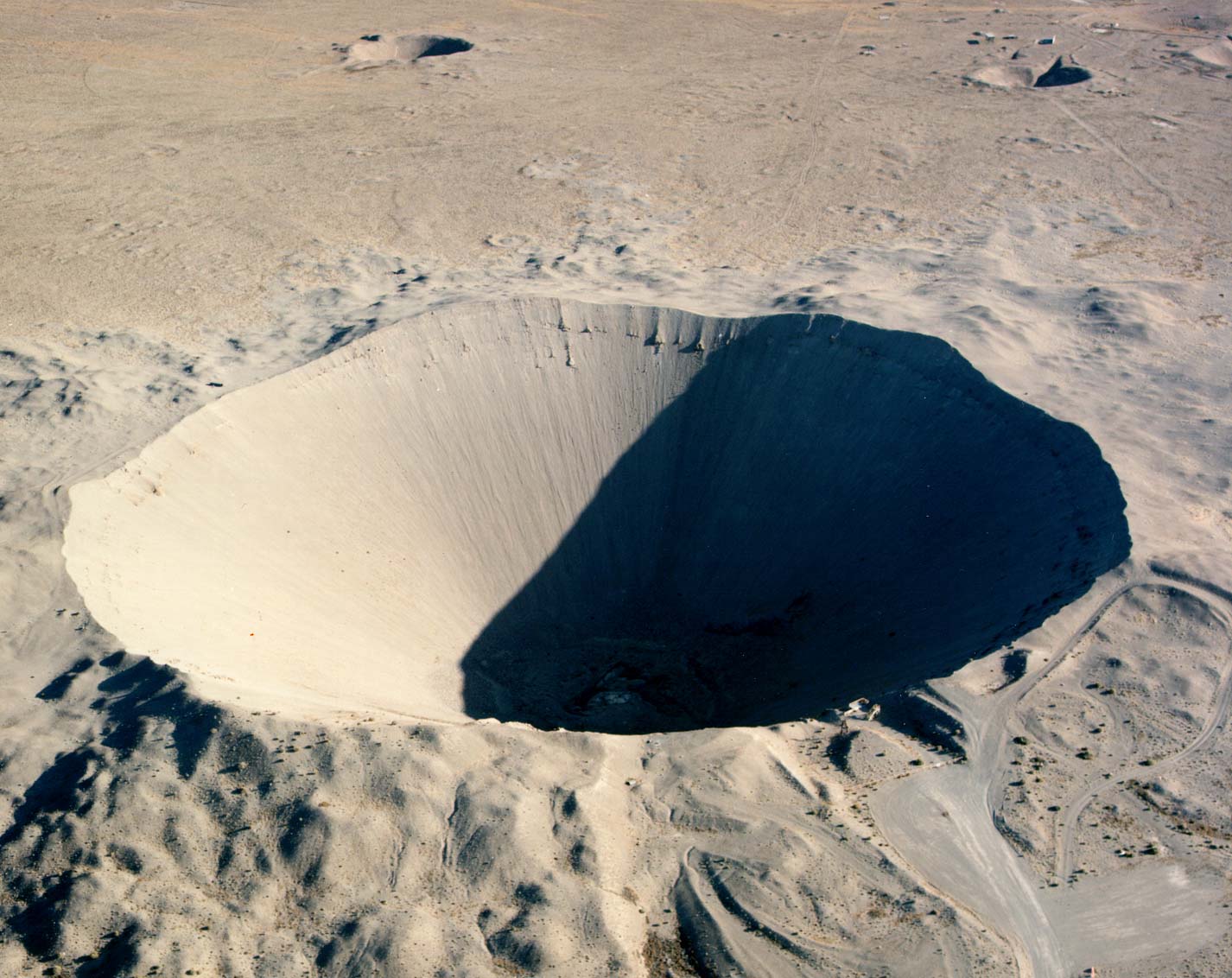 |
| Plowshare Sedan Crater, via Wikipedia |

in 2015, the ATLAS (Asteroid Terrestrial-Impact Last Alert System) is expected to be online, with warnings ranging from a day to three weeks. In a strange mirror, the sizes of asteroid impacts, like nuclear ones, are also measured in megatons (the above linked site calls a "city killer" 5 megatons, and a "county killer" 100 megatons (like the Tsar Bomba).
Monday, February 10, 2014
Mining on the Moon
I thought this was a great article, and Very Pertinent to the Moon/Space fiction that I'm in the early planning stages of writing (hear that? I'm planning!) Mining the Moon: Plans Taking Off but Rules Lacking. The pertinent rule or "rules" here is from the 1967 Outer Space Treaty, wherein the signers agreed that the moon belonged to no nation (I'm sure this is a drastic oversimplification, but there you go). This is also the treaty that bars nuclear weapons and weapons of mass destruction from orbit, or installation on bodies such as the moon or a space station.
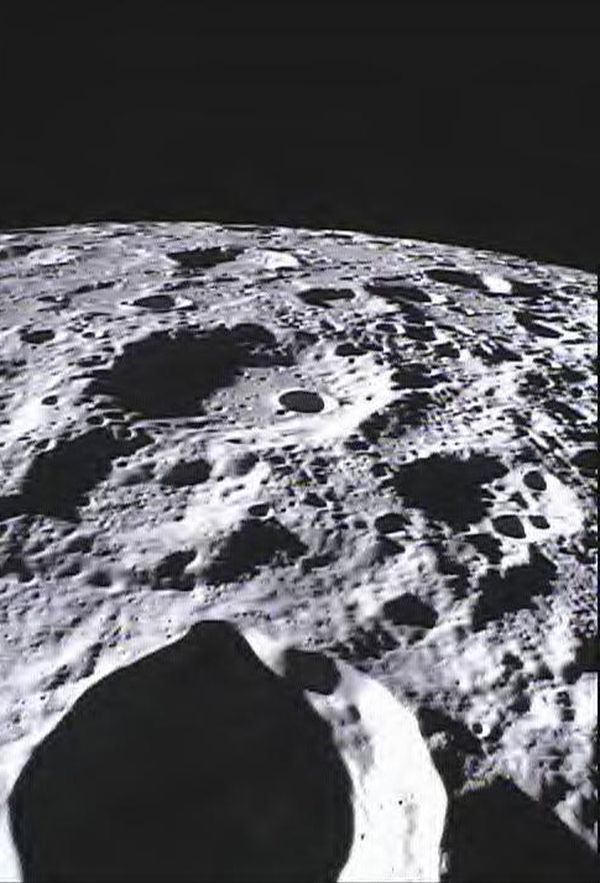 |
| Picture of the moon from NASA Jet Propulsion Laboratory web site |
Wednesday, February 5, 2014
Spacing Out
I discussed my latest science fiction inspiration last week. Untitled as yet, though I do have a main character in mind. I haven't started writing yet, not really. I've got a file of collected sentence fragments; world building, I suppose. Of course, this is research for two space/scifi/moon novels at once. There's a lot of moons, did you know that? Ours, obviously. But
Much like how I intend all of my urban fantasy books to take place "in the same world", whether they're cognizant of if or not, I also intend for my space scifi to take place in its own world. I'm not entirely sure I want these two worlds to be the same. Werewolves in space may not be my thing, savvy? Or, it might be just what we need. Hrm. But I digress. I have to build the culture, and the history, of how my humanity has become spacefaring. I need to decide what's run of the mill for them, and what's out of the ordinary. So I need to build a timeline, and to build a timeline, I need to know what the "real" one is, from V2 rockets on up.

Much like how I intend all of my urban fantasy books to take place "in the same world", whether they're cognizant of if or not, I also intend for my space scifi to take place in its own world. I'm not entirely sure I want these two worlds to be the same. Werewolves in space may not be my thing, savvy? Or, it might be just what we need. Hrm. But I digress. I have to build the culture, and the history, of how my humanity has become spacefaring. I need to decide what's run of the mill for them, and what's out of the ordinary. So I need to build a timeline, and to build a timeline, I need to know what the "real" one is, from V2 rockets on up.
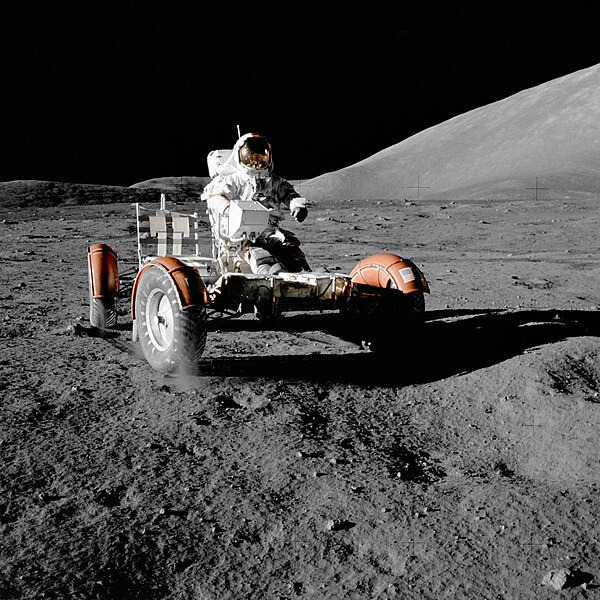
(the Apollo 17 Lunar Roving Vehicle)
Friday, January 31, 2014
What I'm talking about when I talk about Science Fiction
Science Fiction is a continually compelling genre. For me, anyway. Judging from the number of space and clone and and and things coming out, it is for a lot of people.
So, what's my first mental impression when I think "Oh, SciFi"?
Space. Really and primarily, space. Space travel, space ships, worlds that are not Earth. Worlds that may once have been Earth. I sometimes think about things like my brain in a robot body (or a cloned body! Thanks Richard K. Morgan, for Altered Carbon and the subsequent two books. I'd love for there to be more).
If there's a science for it, there's a fiction for it, so Science Fiction possibilities, in my mind, are fairly infinite. But when it comes down to it, when I write (or make gestures at writing) what I think of as "Science Fiction", I'm reaching back to that Golden Age of Space Travel and Possibilities, where Man willingly travels at the behest of his (or her; I'm using "Man" as the gender neutral noun here) government to Explore and Discover and what have you. I want that mood of the indomitable spirit, the inquisitive attitude, the endless question of "What will we find and how will we survive it?"
I've already got an idea somewhat laid out for a near-future Moon novel. I now, I think, have the most nascent dream of a novel somewhere along that timeline, after the events of Untitled Moon Novel are said and done, and we (meaning Earth People) have moved even further.
What do you think of when you think of SciFi, be it books or movies?
So, what's my first mental impression when I think "Oh, SciFi"?
Space. Really and primarily, space. Space travel, space ships, worlds that are not Earth. Worlds that may once have been Earth. I sometimes think about things like my brain in a robot body (or a cloned body! Thanks Richard K. Morgan, for Altered Carbon and the subsequent two books. I'd love for there to be more).
If there's a science for it, there's a fiction for it, so Science Fiction possibilities, in my mind, are fairly infinite. But when it comes down to it, when I write (or make gestures at writing) what I think of as "Science Fiction", I'm reaching back to that Golden Age of Space Travel and Possibilities, where Man willingly travels at the behest of his (or her; I'm using "Man" as the gender neutral noun here) government to Explore and Discover and what have you. I want that mood of the indomitable spirit, the inquisitive attitude, the endless question of "What will we find and how will we survive it?"
I've already got an idea somewhat laid out for a near-future Moon novel. I now, I think, have the most nascent dream of a novel somewhere along that timeline, after the events of Untitled Moon Novel are said and done, and we (meaning Earth People) have moved even further.
What do you think of when you think of SciFi, be it books or movies?
Wednesday, November 13, 2013
Living History
The Smithsonian just came out with a book called The History of American in 101 Objects. They also had a full issue of their magazine devoted to said objects, if a bit more briefly than the book clearly does. Flipping through the magazine, I got caught up a moment on how many modern things were there. "How can it be history," I thought, "if it's modern?"
Well, silly me. Just because we're living it doesn't mean it isn't history.
Years from now, something that happened today will be history. Hell, something is history as soon as it's happened. Whether it's important history is to be decided later, obviously.
Some things are apparent. When Buzz Aldrin et. al. were on the Moon missions, it was history. They knew they were making history, living it. Funny thing: one of the 101 objects is Neil Armstrong's Space Suit. Another member of my household left the magazine folded open to that, and I happened to lay the book I'm reading, Moondust by Andrew Smith, on top before I took notice. I'm not very far into it, but the introduction was fantastic, and the first chapter is also delivering. I scored it in the library book sale for $1 the day after I decided I was writing a Moon novel. How's that for the universe taking notice?
I actually met one of the Moon landing astronauts, when I was 6 or so. He came to the Jersey Shore Medical Center, where my grandmother was a secretary in the Pathology department. I'm not really sure why the astronaut came to the hospital in 1989 or so, but whatever. The program was supposed to be for children 8 and older, but my dad lied so I could go. I didn't realize the importance, not really, but he realized for me. I'm thankful.
It was Charles "Pete" Conrad, and I have an autographed photo of him that my grandmother framed for me. He died in 1999 due to injuries from a motorcycle accident and is buried in the Arlington Cemetery. He was the commander of Apollo 12, and he was one of the first people to board Skylab.
One of the things I learned from American Gods, which I'm able to generalize a great deal, is a quote from Herodotus: "Call no man happy until he is dead." The notion being you can't take stock and make decision of an entire life until it is over (I may have paraphrased. I don't think it changes the point of the quote if I did.) I have, in the course of dog message board discussions, said "Call no man healthy until he is dead." Because that's the thing: if people are breeding dogs for health, they don't exactly know the "final results" until after a dog has lived his or her entire life. Some Dobermans drop dead as early as 2 or 3 from DCM. Others don't until they're 6 or 8. Some live a great deal longer. Some get cancer, some get bloat. But you don't know, not really.
But you don't know about anything. You just try to do the best you can.
Well, silly me. Just because we're living it doesn't mean it isn't history.
Years from now, something that happened today will be history. Hell, something is history as soon as it's happened. Whether it's important history is to be decided later, obviously.
Some things are apparent. When Buzz Aldrin et. al. were on the Moon missions, it was history. They knew they were making history, living it. Funny thing: one of the 101 objects is Neil Armstrong's Space Suit. Another member of my household left the magazine folded open to that, and I happened to lay the book I'm reading, Moondust by Andrew Smith, on top before I took notice. I'm not very far into it, but the introduction was fantastic, and the first chapter is also delivering. I scored it in the library book sale for $1 the day after I decided I was writing a Moon novel. How's that for the universe taking notice?
I actually met one of the Moon landing astronauts, when I was 6 or so. He came to the Jersey Shore Medical Center, where my grandmother was a secretary in the Pathology department. I'm not really sure why the astronaut came to the hospital in 1989 or so, but whatever. The program was supposed to be for children 8 and older, but my dad lied so I could go. I didn't realize the importance, not really, but he realized for me. I'm thankful.
It was Charles "Pete" Conrad, and I have an autographed photo of him that my grandmother framed for me. He died in 1999 due to injuries from a motorcycle accident and is buried in the Arlington Cemetery. He was the commander of Apollo 12, and he was one of the first people to board Skylab.
One of the things I learned from American Gods, which I'm able to generalize a great deal, is a quote from Herodotus: "Call no man happy until he is dead." The notion being you can't take stock and make decision of an entire life until it is over (I may have paraphrased. I don't think it changes the point of the quote if I did.) I have, in the course of dog message board discussions, said "Call no man healthy until he is dead." Because that's the thing: if people are breeding dogs for health, they don't exactly know the "final results" until after a dog has lived his or her entire life. Some Dobermans drop dead as early as 2 or 3 from DCM. Others don't until they're 6 or 8. Some live a great deal longer. Some get cancer, some get bloat. But you don't know, not really.
But you don't know about anything. You just try to do the best you can.
Subscribe to:
Posts (Atom)