Showing posts with label space. Show all posts

Saturday, October 24, 2020

Now Available! "Know They Will Die, Under the Salt of It" in The Future Fire

 My science fiction short story "Know They Will Die, Under the Salt of It" is now available to read in The Future Fire!

I wrote this story in 2018, after I happened across an article in Outside about freediving. So then I read three more. I didn't really know what I was going to do with it yet, but that's just part of my process; I just put as much into my brain as I care to, and stories come out, some sooner, some later. 

The title come from the Carl Sandburg poem "Young Sea" and it is a title that I'm happy with. I feel like it both catches the freediver spirit, and the reality of those who live by the ocean and work closely with it,  and also the reality of what is happening in the story itself. 

This is one of two stories that I've written about not-really-successful space colonies; the other is "Black Market Cheerios," and appeared earlier this year in Lamplight Volume 8, Issue 2. They are not related stories in any further sense; they don't share characters or anything. But they are both stories that I am very pleased with, and I am happy that they have found homes!

Sunday, November 20, 2016

NaNoWriMo 2016: cyberpunk sequel madness (and assorted esoteria)


I know you're all very surprised, I'm doing NaNoWriMo this month. And can I say how goddamn delighted I am by the SPAAAAAAAAAAAAAAAAAAACE theme that the flair has? I already bought a participant t-shirt, and I'm debating on when to order the winner shirt (I haven't won yet, but....)


I'm not writing a space novel this year (though I did last year!). No, this year I'm writing the sequel to the novel that I wrote in July for CampNaNoWriMo. I really liked those characters, actually, though I will confess that bits and pieces of their personalities and tics may or may not come from characters I've played, and may end up in some way familiar to people who were in those games with me. Other things, most things, are fresh. But, in July, the novel was a cyberpunk diamond heist carried out by three young independent women. This month, the novel is two of the three, and something to do with militias and hijacking army supplies and what they spent their money on from all those diamonds. Because the characters don't know yet, I don't have to know yet, isn't that great? I think that's great.

Monday, December 22, 2014

What's inspiring me right now

So I kind of already had space scifi in mind for a future/next project.

Then I saw this .gif somewhere (I've sourced it from Daily Mail in this linkage). It's what astronauts see out the window on reentry.

Friday, November 14, 2014

Is that a comet I hear?

This is what Comet 67P/Churyumov/Gerasmenko sounds like, if it's tinkered with a bit so the sound is in a range humans can hear:  http://www.iflscience.com/space/rosetta-s-comet-sounds-lot-predator

Pretty cool, I thought. It's easy, on the Internet, to click through things super fast without taking a moment to consider what you're doing. I mean, stop and listen to that. Listen to the whole thing.

This is a rock flying through space, which no human has set foot on. Remotely, we've put a spacecraft near it, and from that spacecraft landed another craft on it to study it. The guy at The Oatmeal illustrated an amusing comparison in some peoples' abilities with regards to this.


But wait, there's more. Some of these were recorded by a space probe in 2001. Again, the pulses or whatever are not in an audible range for the human ear, and so they had to be tinkered with.

Monday, May 12, 2014

Eye in the Sky

So I said to my coworker: "Hey, the ISS put cameras on the outside of it, so you can watch it live stream Earth."

"Is it boring?" she asked.

I thought about it. "On one hand, yes. On the other hand, you're watching EARTH from SPACE in real time. It's simultaneously amazing and boring, and that such a thing can be both at once is absolutely mind blowing." She thought about it as well, and concurred.

The link I provided is on the Johnson Space Center portion of the NASA web site. It's neat because it shows you what the International Space Station is streaming in one window, and then shows you where above Earth the ISS is as well; it shows you where on Earth is nighttime, what time it is, etc. There are four cameras it can swap between. The Johnson Space Center is in Houston, Texas, which is also (I believe) where Mission Control, Houston is. So "Houston, we've had a problem here" during the Apollo 13 mission? That's who those guys were talking to.

But call up the livestream, and look at it for a little while. Put your boredom away and let the wonderment creep in. You're not going to see baby animals, you (hopefully) won't see much happen at all. But at the same time? You are watching what is almost literally everything. You can see the real horizon, the glowing curve of the planet we all live on and have to come from. You can see the solar arrays of the ISS. And sometimes? You can see some lights down here, when it all grows dark.

Wednesday, April 9, 2014

The Ethics of Space Travel

You'd think somebody with as much nuclear paranoia as mine would have considered the amount of radiation a person would be exposed to on a trip to Mars. But I didn't. I think to some degree, I assumed ships were shielded and left it at that. It's how it works in the movies, right?
Picture of Space Shuttle Atlantis, from NASA web site


Wednesday, March 26, 2014

Selections from my bookmarks

I've been bookmarking links for years. You know how it goes; you see something you want to read, but maybe you're not in the mood for it right that second. Or maybe you don't have time. So it goes.

My bookmarks are fairly..er.."organized". I have many folders, have had good intentions for all of the headings. Some of them pertain directly to particular writing projects (so I've got ones called "Rebel yell" and "Detroit"), at least three are for recipes I've almost certainly never cooked, and many are just things I thought might be interesting. One folder is called "inspiration", because of the piles of information in it, there's sure to be story fodder.

So, while looking at those bookmarks instead of editing The Last Song, I found a few I figured I'd share. In a way, they're loosely connected in my mind.

I thought these pictures were eye-catching, and would eventually lead me to some story or another. They're all from the 40's, if memory serves, though they're in color (!).

This one is from XKCD, and is a Radiation Dose Chart, using Sieverts, which is the unit for an absorbed dose, named after Rolf Maximilian Sievert, who studied the biological effects of radiation.

Here's A-E on The Observatory ~ The Tough Guide to the Known Galaxy. Links on the bottom take you to the rest of the definitions on the site. I'm glad I re-found this one, as I've been trying to build the vernacular for my science fiction space culture. The writer also has the blog Rocketpunk Manifesto, which looks to have even more great information on it.

And I forgot about this charming Forbes article, Why I Named my Dog After Neil Armstrong, published in 2012 not long after Neil Armstrong himself passed away.

Wednesday, February 19, 2014

Accuracy and Science in Space Sci Fi

So there's this Tumblr, Things that Cost More Than Space Exploration written (curated?) by somebody who takes Tumblr as a medium seriously, which is pretty cool in and of itself. The examples given are also pretty cool.

I found the Tumblr at the same time I located and perused this non fiction book, Scientific American: Inventions from Outer Space: Everyday Uses for NASA Technology, by David Aaron Baker. It includes things like actual UV protection glasses lenses (I guess there's a gel layer or something? I've only skimmed it so far) and water purifiers (both particularly useful things in space, one would assume).
Coronal Loops in the active region of the sun, from NASA website


And speaking of NASA, I watched the movie Europa Report the other day. Apparently NASA (or maybe just one NASA scientist? I'm a little unclear) had input in the movie's development, trying to make the space travel as realistic as possible. I dug it, for the most part, with only a few nitpicky problems (WHY WOULD YOU TRIM SOMEBODY'S HAIR ON A SPACE SHIP?!). My demand for accuracy notwithstanding, I'm able to suspend my disbelief fairly well in the watching of movies, only revisiting them later and realizing my dissatisfaction with certain points. I'd seems I'd heard NASA has an interest in being involved with peoples' scifi, to help with accuracy and such (And perhaps get more attention in the public eye, so maybe they can get some more funding again....), and there is a crapload of information on the NASA website, from fact sheets on research centers to pictures taken by our various picture taking devices (Hubble, etc.) There's even a NASA Kids Club!

 I happened upon Europa Report as a "You might like this if you watched Event Horizon", and so of course, I've fond subsequent titles for if I liked Europa Report (Apollo 18, Moon).  But anyway, flaws aside, Europa Report does use some real science, and I felt it was well acted (though they did this thing where two of the male main characters were of a certain build and coloring, so I was constantly going "Wait, is it a crew of six? Is it five? Is the thriller part of this movie that there's a GHOST CREW MEMBER? Oh no, there's the sixth guy. Okay."

So now I kind of want a movie or book with a ghost crew member. Which might also have to do with having watched the anime Another, in which a specific third-year high school class would frequently develop a ghost classmate.

Wednesday, February 5, 2014

Spacing Out

I discussed my latest science fiction inspiration last week. Untitled as yet, though I do have a main character in mind. I haven't started writing yet, not really. I've got a file of collected sentence fragments; world building, I suppose. Of course, this is research for two space/scifi/moon novels at once. There's a lot of moons, did you know that? Ours, obviously. But

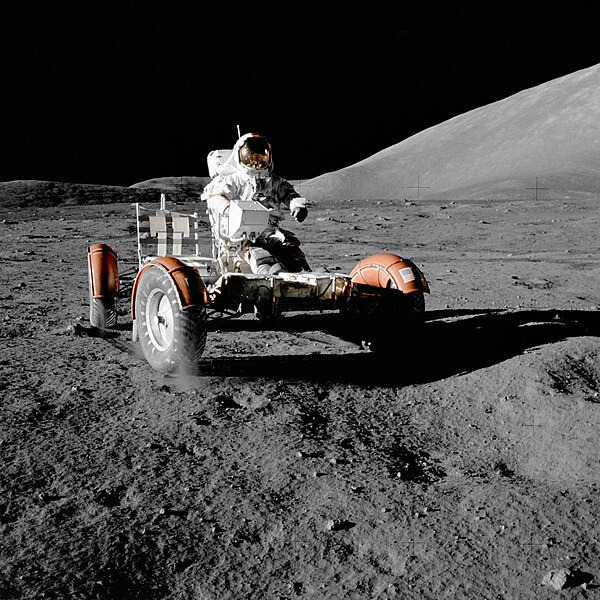
Much like how I intend all of my urban fantasy books to take place "in the same world", whether they're cognizant of if or not, I also intend for my space scifi to take place in its own world. I'm not entirely sure I want these two worlds to be the same. Werewolves in space may not be my thing, savvy? Or, it might be just what we need. Hrm. But I digress. I have to build the culture, and the history, of how my humanity has become spacefaring. I need to decide what's run of the mill for them, and what's out of the ordinary. So I need to build a timeline, and to build a timeline, I need to know what the "real" one is, from V2 rockets on up.

(the Apollo 17 Lunar Roving Vehicle)

Friday, January 31, 2014

What I'm talking about when I talk about Science Fiction

Science Fiction is a continually compelling genre. For me, anyway. Judging from the number of space and clone and and and things coming out, it is for a lot of people.

So, what's my first mental impression when I think "Oh, SciFi"?

Space. Really and primarily, space. Space travel, space ships, worlds that are not Earth. Worlds that may once have been Earth. I sometimes think about things like my brain in a robot body (or a cloned body! Thanks Richard K. Morgan, for Altered Carbon and the subsequent two books. I'd love for there to be more).

If there's a science for it, there's a fiction for it, so Science Fiction possibilities, in my mind, are fairly infinite. But when it comes down to it, when I write (or make gestures at writing) what I think of as "Science Fiction", I'm reaching back to that Golden Age of Space Travel and Possibilities, where Man willingly travels at the behest of his (or her; I'm using "Man" as the gender neutral noun here) government to Explore and Discover and what have you. I want that mood of the indomitable spirit, the inquisitive attitude, the endless question of "What will we find and how will we survive it?"

I've already got an idea somewhat laid out for a near-future Moon novel. I now, I think, have the most nascent dream of a novel somewhere along that timeline, after the events of Untitled Moon Novel are said and done, and we (meaning Earth People) have moved even further.

What do you think of when you think of SciFi, be it books or movies? 

Friday, July 19, 2013

More Realistic Space Travel for a Brighter SciFi Future

I've mentioned numerous times (though not enough for them to give me money, apparently) that I'm a reader of Cracked.com. Their articles tend to be well (or at least amusingly) written, they give lots of links, there are pictures. I don't watch the videos, or look at the fan photo things. No, I look at the list posts. In the past, Snopes.com has also filled this sort of "fascination niche" for me.

Though I'm not currently writing any kind of SciFi space offering, I intend to one of these days. I sort of did, for the NaNo of 2008. I'm pleased with parts of it, though not really the scale, and it's hung on enough of an Atlas Shrugged framework that the Ayn Rand institute would not appreciate my homage, I daresay.  What does this have to do with Cracked? Well, they have articles on space, as one might imagine. One in particular that caught my attention and my writerly focus is 6 Reasons Space Travel Will Always Suck. In science fiction, the concerns this article brings up aren't typically addressed, with few notable exceptions. The Cold Equations is one of them.

Also  (and I'm surprised at myself that I didn't talk about this here at the time. I meant to, certainly), I'm probably one of the only people in the world who, when they saw Chris Hadfield's "Space Oddity" cover, wondered if he smuggled that guitar onboard because I knew weight was such an issue with packing for space (though it occurs to me as well that I read Mary Roach's Packing for Mars, in which I'm sure she addressed these rules and their more recent changes). On December 16, 1965, the guys in the Gemini 6   in Earth's Orbit played "Jingle Bells" on their contraband sleighbells and teeny tiny harmonica, which you can see in this Smithsonian article.

Another Cracked article is the 6 Weirdest Dangers of Space Travel, including things like static electricity and being unable to stop. Less glamorous aspects of the Space Opera, certainly, and by "less glamorous" I mean "nobody in Star Wars once had a problem getting zapped by a random thing they touched." Or, for fun, draw your own comparison.

So, while Science Fiction I write is still going to be far more fictional than sciencey (that's just the way it goes), I'm still a big fan of using enough factual material to lend reality to the story I'm building. It's easier to suspend one's disbelief if there are facts in the mix; it makes the falsehoods a less bitter pill to swallow.

I'm still pretty sure I'll leave out the unicorns, though.